|
|
 |
READ MY CV
 Download PDF Download PDF
|
LAB WEBSITE

|
| |
|
PUBLICATIONS


|
|
SOCIAL NETWORKS




|
|
|
|
AFFILIATIONS





|
|
|
|
|
|
Clinical Tools
|
Here is a growing list of tools that I use in gathering clinical data and with patients/clients. If you use any of these, make sure to acknowledge the source. Also note that many of these resources are copyright their respective owners, and are provided for informational use only. Therefore, I believe that this constitutes "fair use" as defined by law. Please respect the owners' copyrights.
| PVT-TOUCH: Psychomotor Vigilance Task for Android |
 |
Psychomotor Vigilance Task (Android Version): The PVT was developed by Dr. David Dinges over 20 years ago and remains the most well-validated indicator of performance deficits attributable to sleep loss. This version was developed to work on touchscreen Android devices. It is still in development, so the current version is a protototype. The PVT-Touch software is free for non-commercial research use.
To access the PVT-Touch, you must first complete this form: http://www.sleephealthresearch.com/pvttouch
References:
Original Publication of the PVT: Cite: Dinges DF, and Powell JW. (1985). Microcomputer analyses of performance on a portable, simple visual RT task during sustained operations. Beh Res Meth Instr Comp 17:652-655.
Development of the PVT-Touch: Kay M, Rector K, Consolvo S, Greenstein B, Wobbrock JO, Watson NF, and Kientz JA. (2013). PVT-Touch: adapting a reaction time test for touchscreen devices. Proceedings of PervasiveHealth 2013: The 7th conference on pervasive computing technologies for healthcare.
Initial validation of the PVT-Touch: Kay M, Grandner M, Bauer J, Lang R, Watson NF, and Kientz JA. (2013). Initial validation of an Android-based psychomotor vigilance task. SLEEP 36 (Abstract supplement): a108.
|
| SPAQ: Sleep Practices and Attitudes Questionnaire |
|
Sleep Practices and Attitudes Questionnaire: The SPAQ was developed over the course of several years to capture how and why people sleep the way they do in the real world. The questionnaire was built around health behavior theory, focued on the Health Belief Model, Theory of Planned Behavior, and Transtheoretical Model.
To access the SPAQ, contact me.
The SPAQ is free to use for non-commercial research purposes. It must be licensed for other purposes and cannot be re-distributed without permission.
References:
Grandner, M. A., Jackson, N. J., Gooneratne, N. S., and Patel, N. P. (In Press). The development of a questionnaire to assess sleep-related practices, beliefs and attitudes. Behavioral Sleep Medicine. NIHMSID:478467.
Grandner, M. A., Patel, N. P., Jean-Louis, G., Jackson, N. J., Gehrman, P. R., Perlis, M. L., and Gooneratne, N. (2013). Sleep-related behaviors and beliefs associated with race/ethnicity in women. Journal of the National Medical Association, 105(1), 4-15.
|
| ASE: Assessment of the Sleep Environment |
|
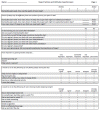
Assessment of the Sleep Environment: The ASE was developed to quickly and comprehensively measure the degree to which the physical environment disturbs sleep. It is brief, easy to administer, and quick to score.
To access the ASE, complete the online form.
The ASE is free to use for non-commercial research purposes. It must be licensed for other purposes and cannot be re-distributed without permission.
References:
Olivier, K., Gallagher, R. A., Killgore, W. D. S., Carrazco, N., Alfonso-Miller, P., Gehrels, J., and Grandner, M. A. (2016). Development and initial validation of the assessment of sleep environment: A novel inventory for describing and quantifying the impact of environmental factors on sleep. SLEEP, 39 (Abstract Supplement): A367.
|
| Other Clinical Sleep Tools: |
|
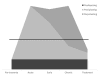
2-Process Model (Handout): Originally developed by Borbely, this model helps illustrate sleep-wake regulation in the context of circadian rhythm. |
|
3-P Model (Handout): Originally developed by Spielman, this model explains how insomnia develops and identifies perpetuating factors as the focus of treatment. |
|
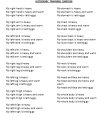
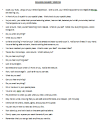
Autogenic Training Exercise: This exercise is sometimes helpful for individuals who have difficulty falling asleep. It involves saying phrases about your body and how it is feeling, which have been shown to be relaxing. |
|
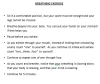
Breathing Exercise: This handout walks patients through a breathing exercise. No handout is good enough to teach diaphragmatic breathing, but I use this as a reminder for people to take home. |
|
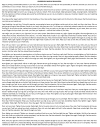
Jet Lag Tips (Handout): This handout includes a list of tips for helping to combat jet lag. Although individual situations vary, this list may be helpful and can be customized. |
|
|
|
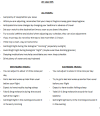
Relaxing Imagery Script: This script walks patients through a complex exercise where they imagine a relaxing scene. Using their senses, they engage this image and make it richer. This can be a powerful relaxation technique if used properly. |
|
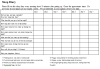
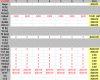
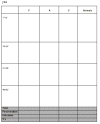
Sleep Diary (Handout): This is an example sleep diary for use with patients to record their sleep. It holds 1 week of data and captures time in bed, sleep latency, total sleep time, awakenings, wake after sleep onset, overall sleep quality and morning sleepiness. |
|
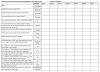
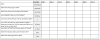
Sleep Diary from Clinic (Handout): This is the handout that I use with patients in my clinic to record their sleep. It holds 1 week of data and captures time in bed, sleep latency, total sleep time, awakenings, wake after sleep onset, overall sleep quality and morning sleepiness. Because many patients also have comorbidities, it also tracks medications, naps, and physical/mental symptoms. |
|
|
|
|
|
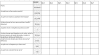
Sleep Diary (Excel Template): This Excel template goes with the handout. Fields in red are automatically computed so they should not be edited. Highlighted fields are weekly averages. Hidden columns are for computations. Times should be entered with hours, minutes and AM/PM separately (except midnight is 0:00 AM instead of 12:00 AM). |
|
Sleep Hygiene Tips (Handout): This is a handout that lists all of the useful sleep hygiene tips. Note that these may not apply to everybody, but this list is easy to edit and customize. |
|
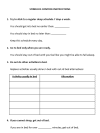
Stimulus Control (Handout): This is a handout that can be used to aid in Stimulus Control Therapy. It includes basic stimulus control instructions, suggestions for out-of-bed activities, and other guidelines for the patient to participate in therapy. |
Other General Clinical Tools: |
|
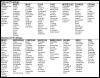
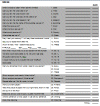
Feeling Words: A list of words to describe feelings, both positive and negative. Many patients with affectove disorders (such as depression), cognitive problems, or other disorders that produce fluctuations in mood find it difficult to express their feelings, or find labels for their feelings -- especially positive. This list of words is meant to help those people. |
|
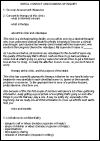
First Session Outline: An outline for intake interviews. This covers a basic psychological intake, including consent, presenting problems, history of problems, family and social history, medical history, psychological history, and characterizing current state. It also sets up further sessions. This is a good outline for students and others learning how to structure an initial interview. |
|
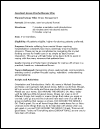
Inpatient Group Psychotherapy Plan: This is a brief manual for an inpaient group that I developed for the UCSD inpatient unit. It was designed as a "Stress Management" group, as patients who suffer from schizophrenia, bipolar disorder, severe depression, or any of the other conditions that would lead them to the inpatient unit all have some difficulty with stress management on a number of levels. This format allows the prticipants to share common experiences in a relatively unstructured setting, compared to other activities. Please contact me if you are interested in utilizing this group. |
|
Letter and Category Fluency: Anyone who is familiar with any kind of neuropsychological testing should be familiar with the Letter and Category Fluency tests (otherwise known as F A S and Animals). For those who want a simple handout for administration and scoring, this should be useful. A good citation for this test is: Gladsjo JA, Schuman CC, Evans JD, Peavy GM, Miller SW, Heaton RK. Norms for letter and category fluency: demographic corrections for age, education, and ethnicity. Assessment. Jun 1999;6(2):147-178. |
|
Mini Mental Status Exam: The Folstein Mini Mental Status Exam is a standard instrument in cognitive assessment, especially for dementia. Many versions exist online, but this one should be easy to follow, administer and score. However, only trained and qualified personnel should use this, as this measure has many limitations. Cite: Folstein MF, Folstein SE, McHugh PRo Mini-mental state. A
practical method for grading the cognitive state of patients for
the clinician. J Psychiatr Res 1975;12:189-98. |
|
© 1995-2018 Michael Grandner
Office: 1501 N. Campbell Avenue, Suite 7326A, PO Box 245002, Tucson, AZ 85724-5002
Phone: (520) 626-6346 | Email:
Page viewed
|
|
|